2025 FIFA Club World Cup and ‘conflict of interest’ issue
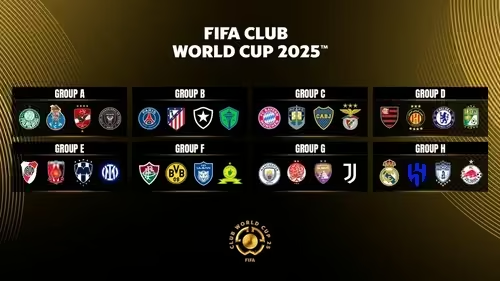
Ahead of the FIFA Club World Cup in the U.S. in 2025, the issue of multi-club ownership was brought to the surface. Mexican clubs Pachuca and León, owned by the same holding group, have both qualified for the tournament. This sparked immediate concerns over competitive integrity and potential conflicts of interest. FIFA ultimately disqualified León and selected a replacement team.
This isn’t just a one-off dispute. It’s a revealing case that exposes the broader complexities of the growing Multi-Club Ownership (MCO) system in modern football.

What Is Multi-Club Ownership?
Multi-club ownership refers to a system in which a company or investment group owns or manages multiple football clubs at the same time. Examples include:
- City Football Group: Owns Manchester City (England), New York City FC (USA), Girona FC (Spain), and over 12 other clubs globally
- Red Bull Group: Operates RB Leipzig (Germany), Red Bull Salzburg (Austria), and New York Red Bulls (USA)
- 777 Partners: Holds interests in Genoa (Italy), Sevilla (Spain), Vasco da Gama (Brazil), among others
While the system has the advantage of integrating funds, club management, and scouting resources, it also comes with a variety of concerns, including conflicts of interest and damage to fair competition.
Advantages of the Multi-Club System
- Risk Diversification: Clubs within a group can balance each other’s financial ups and downs.
- Youth Development and Player Flow: Young talents can mature at smaller clubs and move up within the system.
- Shared Resources: Data, marketing strategies, and operational models can be unified, saving costs and increasing efficiency.
Disadvantages of the Multi-Club System
- Competitive Fairness: When clubs from the same ownership group face each other in FIFA or UEFA competitions, doubts about fair play emerge.
- Loss of Club Identity: Local culture and fan traditions can fade under a centralized, corporate structure.
- Unfair Transfer Advantages: Internal transfers between sister clubs can distort market parity.
FIFA’s Position and Future Regulatory Direction
FIFA did not provide clear global standards and solutions, but this case of the 2025 Club World Cup made us aware of the need to establish standards. Here are the possible future regulatory directions
- One Team Per Tournament Rule: Clubs under the same ownership may be restricted to one entry per competition.
- Mandatory Transparency: Ownership structures and decision-making hierarchies must be disclosed.
- Transfer Monitoring: FIFA may review intra-group transfers to ensure market fairness.
Global vs Fairness
Personally, this issue is about whether fans can trust this system. The multi-club structure was created in the early days for the globalization of the football industry. However, if the sport of football is still operated by “emotional” and “local loyalty,” I am concerned that it goes to a multi-club structure without clear standards.
Victories feel hollow when fans suspect the system isn’t level. FIFA’s mission shouldn’t be to ban the model, but to restore credibility through smart, transparent governance.
The problem that FIFA should be solved
The multi-club controversy at the FIFA Club World Cup in 2025 is not just a matter of participation in one tournament, but a microcosm of the structural woes facing football around the world.
How FIFA chooses to respond may shape the soul of global football for the next generation.